A woman in Freeport pointed at a coffee-colored stain on her ceiling last spring and asked us to “patch that one spot.” Twenty minutes later, our assessor had marked four more stains on the same ceiling she hadn’t noticed, found a soft area on the wall under the window, and traced everything back to a flashing failure on the second-floor dormer. The patch she wanted would have lasted a season at best.
That’s the gap a real property damage assessment exists to close. Not the obvious stuff. The hidden stuff you can’t see from the floor, can’t smell yet, and won’t notice until it shows up as a much bigger problem six months from now.
Walking the Property Before Anything Gets Opened Up
The first thing a trained assessor does is slow down. We walk the perimeter outside before stepping into a single room inside. Roofline, gutters, soffit, siding, flashing, foundation, grade slope around the house. Most of what shows up indoors started outside, and you can’t diagnose the inside without knowing what the outside is doing.
Once we move indoors, the walk is structured. We start at the entry point of the damage if it’s known, then work outward room by room. We’re looking, smelling, listening, and touching. Ceilings, walls, baseboards, floors, around plumbing fixtures, behind toilets, under sinks. Each room takes longer than people expect, which is fine. Rushing this part is how you miss the thing that matters.
In Freeport, we also pay extra attention to attic spaces and any rooms on the west or south side of the house. Our prevailing summer storms hit those exposures hardest, and a lot of slow leaks announce themselves there first.
The Tools That Tell the Real Story
A walk-around tells you what’s visible. The tools tell you what’s behind the drywall. Here’s what’s usually in the truck:
- Moisture meter. Pin and pinless versions. The pinless rolls across a wall and reads moisture content without leaving holes. The pin version goes in for confirmation when something looks suspicious.
- Thermal imaging camera. Wet materials cool faster than dry ones because of evaporation. A thermal image makes a hidden wet spot show up as a cool patch, even through paint and texture.
- Hygrometer. Reads relative humidity in the room. In a Freeport home in July, this matters. If a space sits above 60 percent humidity all day, mold conditions exist whether you see mold yet or not.
- Borescope. A flexible camera on a long cable. Lets us look inside a wall cavity through a small hole instead of opening the whole wall to find out what’s in there.
None of this is high theater. It’s just a faster way to find the truth without tearing into materials we might not need to touch.
Documenting Damage the Way an Adjuster Wants to See It
Here’s where a lot of cheaper assessments fall apart. The visual inspection might be fine, but if the documentation can’t be handed to an insurance adjuster in a format they recognize, your claim stalls. We’ve watched homeowners get stuck for weeks because the report they paid for didn’t include the right photos, measurements, or moisture readings.
A proper assessment package usually includes:
- Wide and close-up photos of every affected area, with consistent labeling
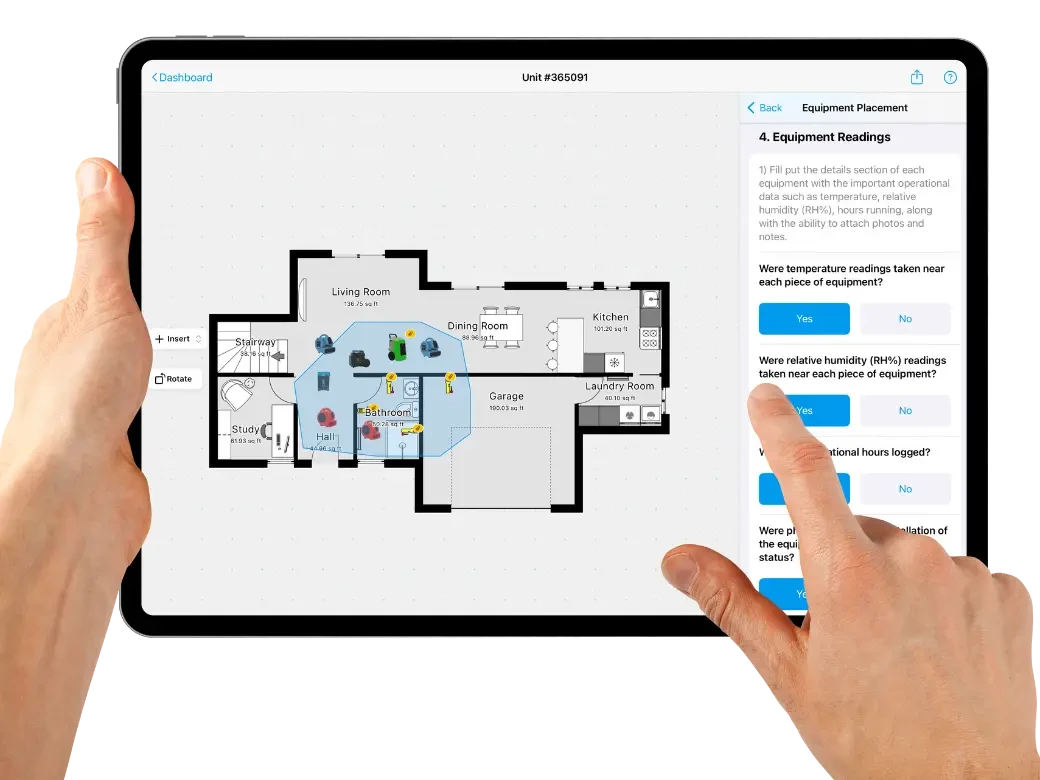
- A floor plan or sketch with damage zones marked
- Moisture readings tied to specific locations and dates
- A written scope of work, line by line
- An estimate built in Xactimate or comparable software the adjuster’s system can read
That last point matters more than most homeowners realize. Adjusters work in specific software. When numbers come in matching their format, the back-and-forth shrinks from weeks to days. When they don’t, every line item turns into a phone call.
What We’re Looking For That You Wouldn’t Notice
This is the part that’s hard to write without sounding mystical, but there’s nothing mystical about it. It’s pattern recognition built over hundreds of jobs. A few examples of what trips the trained eye:
A nail head rusting through paint on the ceiling. Looks like a minor paint defect to most people. To us, it’s a sign of repeated moisture cycling in the attic, often from a ventilation problem.
Baseboards that don’t sit quite flush against the floor in one spot. Could be settling. Could also be the subfloor swelling from a slow leak that hasn’t shown up upstairs yet.
A faint musty smell that fades after a few minutes. The fade is your nose adjusting, not the smell going away. There’s moisture somewhere, usually behind something.
Hairline cracks above a doorway running diagonally. Could be normal. Could also be the start of a structural movement issue, especially in homes that took heavy wind load during a recent storm.
Discoloration on the underside of a roof deck, visible from the attic. That’s water that came in and dried, repeatedly. The roof above it is failing somewhere, even if no shingle looks obviously wrong from the ground.
We mark all of it, photograph all of it, and explain all of it. Some of these turn out to be nothing. That’s fine. We’d rather flag five things and have one matter than miss the one that did. In coastal Florida specifically, we’re also watching for salt corrosion on fasteners and metal flashing, attic humidity readings that look fine today but won’t be after the next storm, and sealant failure around any exterior penetration. A lot of our water damage restoration work starts as a single visible stain that, on closer inspection, turns out to involve three rooms.
Our storm damage restoration experience also shapes what we look for here. The next storm is always a question of when, not if, and the assessment is where we identify what’s vulnerable now.
After the Assessment, What Happens Next
A useful assessment ends with a clear picture of three things. What’s damaged, what it will take to fix, and what the order of operations should be. From there, next steps depend on the situation.
For minor issues caught early, repairs may be straightforward and entirely out-of-pocket. For storm or flood events, the report becomes the foundation of your insurance claim, and we usually coordinate directly with the adjuster from that point forward. For situations involving active water intrusion or structural risk, the assessment overlaps with emergency repairs, and crews go to work the same day.
A small piece of advice from someone who’s done this a lot. Don’t wait for the damage to “get worse” before calling for an assessment. The cheapest version of every job we do is the one we caught early. The most expensive is the one that’s been quietly spreading for a year, and by then the conversation isn’t about repair anymore, it’s about replacement.
Curious What an Assessment Would Find at Your Property?
The team at Truvorne Roofing & Restoration is ready to help. Contact us today to schedule a professional property damage assessment in Freeport or anywhere along the Florida Panhandle, and get a clear, documented picture of what your property actually needs.